Main Menu
Duration
Nov. 17 - Dec. 15, 2026
Duration

Enroll before

One-time Payment

Live sessions

Max. seats
Curating involves more than selecting and displaying objects; it also means designing how visitors move through the space, engage with the artwork, and make sense of the exhibition. This course introduces User Experience (UX) design as a framework for exhibition-making, equipping you with strategies to enhance audience connection, understanding, and curiosity in your projects.
Drawing on behavioural psychology, sensory design, spatial storytelling, and audience research, you will learn best practices and practical tools to analyse, design, and implement visitor-centered experiences. By the end of the course, you will be able to transform curatorial concepts into thoughtful, engaging visitor journeys.
Over five weeks you will learn how to:
Understand audiences and translate their different needs into creative exhibition design
Construct conceptual narratives and spatial storytelling plans that support the visitor experience
Foster engagement through emotional and sensory design strategies
Implement and evaluate user experience design approaches during production
This course is for anyone involved in designing, curating, or producing exhibitions (including artists, curators, exhibition designers, and cultural managers) who want to place the visitor experience at the heart of their projects and design engaging, meaningful experiences.
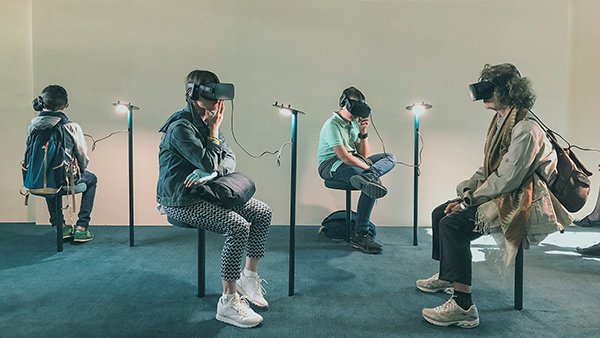
Image: note thanun in Unsplash

The Zoom sessions will be on Tuesdays, from 7pm to 9pm Berlin time CET. Recordings will be available in case you miss a live session!
Session 1: Introductions and Key Concepts of UX Design
In this first session, we will get to know each other and lay the foundations for the course by learning key terms and concepts.
Introductions
Key terms: experiential art, experiential marketing, user experience and experience design
Experience design case studies: specific projects and important institutions
Social, institutional, and economic contexts of experience-led exhibitions: the experience economy
Session 2: Understanding Audiences
In this session, we will learn how audience research and segmentation can be used to design impactful exhibitions.
Strategies to define target audiences
Target audience analysis and segmentation approaches
Visitor Personas
John Falk’s visitor segmentation approach: visitor types and framework for experience design in cultural projects
‘Choice architecture’: Translating audience research into spatial and interpretive design decisions
Session 3: Spatial Storytelling
This session focuses on turning ideas into structured experiences through narrative, spatial design, and emotional engagement.
The 5-Step methodology to conceptual narrative building
Spatial storytelling: approaches and framework
Space syntax and interaction typology
Experience design and emotions
Designing for emotions toolkit
Session 4: Multisensory Design
This session introduces sensory and phygital strategies that deepen visitor engagement through immersive design.
Sensory design for cultural projects
Light and sound design
Olfactory and gustation
Mixed reality technologies
Phygital and multisensory experiences
Session 5: Implementing Experiences
In our final session, we will explore how to bring experience design to life, from production and operations to evaluation and reflection. We will also share our projects developed during the course.
Experience design in the implementation phase
Production: brief and quality control
Operations: visitor experience strategy and implementation
Data collection and lessons learnt
Language
Classes are held in English.
Format & Modality
The course is fully online and taught live via Zoom in small, interactive groups to support active learning. Live captioning is available during the sessions.
Schedule
Live sessions take place every Tuesday from 7pm to 9pm (Berlin time, CET).
Attendance
Live attendance is encouraged to get the most out of the course, but recordings are available if you cannot attend a session.
Course Materials
All course materials—including recordings, readings, and presentations—are available on the Node platform for as long as you wish.
Assignments
Optional assignments are included, with personal feedback from the lecturers to help you apply what you learn. Please note that feedback is provided only during the course dates.
Certificate
A downloadable certificate is available upon course completion.
Technical Requirements
A stable internet connection, a computer with a camera and microphone, and access to Zoom are required.
Questions?
Check our FAQ or contact us via our online form.
Yulia Loginova